Helionet AI is an Inter-Planetary Com and Data Processing System with Argus Helionodes At Sun-Planet and Planet-Moon Lagrange Points
Dive into Helionet’s commitment to integrating sentient robotics and human innovation, fostering exploration at the forefront of interspace technology and sustainable civilization growth.
Helionet AI is a longterm project projected to fulfill its potential sometime around the year 2070. If you wish to delve into the speculative side of what is to come, you will need to read about it through a science fiction perspective. Nothing short of conjectural visualization can possibly encompass the totality of its scientific and engineering capabilities. You need to envision the future to be able to invent the reality. The novel Robot Dawn does precisely that.
Summary of Helionet AI’s Network
Explore crucial data that reveals Helionet’s advancements in satellite integration, sentient robotics, and interspace exploration.
115
Argus Satellite Nodes
The count of self-aware Argus satellites strategically positioned at Solar System Lagrange Points.
(TBD)
Human-Robot Integration Projects
Number of pioneering initiatives blending human ingenuity with sentient robotics technology.
(TBD)
Interspace Missions Launched
Total interspace travel and exploration missions enabled through Helionet’s advanced network.
(TBD)
Collaborative Research Ventures
Detailed account of major scientific collaborations advancing technological civilization within the Solar System.
Argus Satellite Locations Within the Solar System:
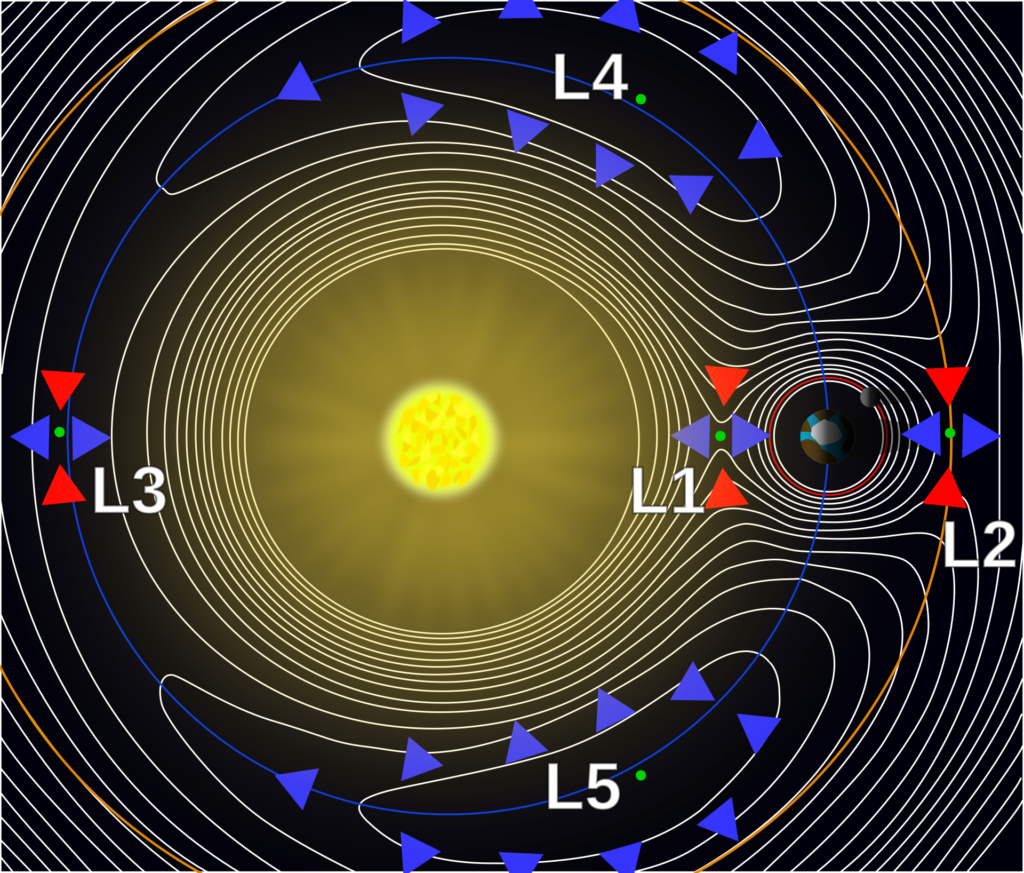
Five Lagrange Points for each pair of large bodies within the Solar System with one body smaller than the other. Three are spread along a line containing the two objects that created them and the other two, L4 and L5, are at positions above and below that line.
Argus satellites are at the following planetary locations for planets or moons larger than a diameter of 100 kilometers. First letter is for the larger body (eg. S = Sun, Me = Mercury, V = Venus, etc.):
Mercury: SMe-L1, SMe-L2, SMe-L3, SMe-L4, SMe-L5
Venus: SV-L1, SV-L2, SV-L3, SV-L4, SV-L5
Earth: SE-L1, SE-L2, SE-L3, SE-L4, SE-L5
Mars: SM-L1, SM-L2, SM-L3, SM-L4, SM-L5
Jupiter: SJ-L1, SJ-L2, SJ-L3, SJ-L4, SJ-L5
Saturn: SS-L1, SS-L2, SS-L3, SS-L4, SS-L5
Uranus: SU-L1, SU-L2, SU-L3, SU-L4, SU-L5
Neptune: SN-L1, SN-L2, SN-L3, SN-L4, SN-L5
Arguses are also at the moons of the following planets:
Earth:
Moon: EMo-L1, EMo-L2, EMo-L3, EMo-L4, EMo-L5
Jupiter:
Ganymede: JG-L1, JG-L2, JG-L3, JG-L4, JG-L5
Callisto: JI-L1, JI-L2, JI-L3, JI-L4, JI-L5
Io: JIo-L1, JIo-L2, JIo-L3, JIo-L4, JIo-L5
Europa: JE-L1, JE-L2, JE-L3, JE-L4, JE-L5
Saturn:
Tethys: ST-L1, ST-L2, ST-L3, ST-L4, ST-L5
Dione: SD-L1, SD-L2, SD-L3, SD-L4, SD-L5
Rhea: SR-L1, SR-L2, SR-L3, SR-L4, SR-L5
Titan: ST-L1, ST-L2, ST-L3, ST-L4, ST-L5
Lapetus: SL-L1, SL-L2, SL-L3, SL-L4, SL-L5
Uranus:
Ariel: UA-L1, UA-L2, UA-L3, UA-L4, UA-L5
Umbriel: UU-L1, UU-L2, UU-L3, UU-L4, UU-L5
Titania: UT-L1, UT-L2, UT-L3, UT-L4, UT-L5
Oberon: UO-L1, UO-L2, UO-L3, UO-L4, UO-L5
Neptune:
Triton: NT-L1, NT-L2, NT-L3, NT-L4, NT-L5
8 planets with populated Lagrange Points. 8 x 5 = 40 Helionodes at planets.
15 planetary moons with populated Lagrange Points. 15 x 5 = 75 Helionodes at moons.
115 Helionodes total. Of course, L3 is never at the planet or moon since it is opposite the larger body from the smaller one.
Meet Our Visionary Team (coming soon)
Chief Systems Architect
Lead Robotics Engineer
Interspace Navigator
AI Integration Specialist